
Think about the person in your business whose departure would cause a genuine problem. There is probably at least one. In a business of thirty people, there are likely several.
When did you last think about that as a risk?
The reason it rarely registers is that it doesn't look like a risk while the person is there. Their knowledge is fully available to the business every day. It just happens to be available only through them, and nobody has noticed the difference between "capability we have access to" and "capability the organisation actually holds."
That distinction stays unconsidered until the day someone resigns. The first response isn't usually "how do we replace their output." It's "wait – does anyone else actually know how this works?" That question, raised during a four-week notice period, is Capability Debt being called in.
Capability Debt is a structural design problem: whether expertise sits in the organisation or only in the individuals currently working there.
The Cost of Capability Debt
Every business accumulates Capability Debt. The account manager who has "just always handled" a difficult client relationship. The developer who understands why a workaround exists that nobody else has touched in three years. The operations lead who holds the informal map of who to call when something breaks. None of it is written down. All of it works – until it doesn't.
The marker of Capability Debt isn't that knowledge exists in a person. Knowledge always exists in people; that's not a problem. The problem is when it exists *only* in that person, and the gap between what they know and what the organisation knows has gone unexamined.
Growing businesses are especially exposed to this. In a small team with high shared context, tacit knowledge is a reasonable operating model. When everyone already knows everything, documentation feels like overhead. That logic works at five people. At twenty-five, it's a liability, because the ratio of things one person knows to things that are written down keeps getting worse, not better, unless someone deliberately addresses it.
For businesses that use fractional or contractor talent for specialist work, the exposure is accelerated. The relationship is explicitly time-limited, which means the knowledge-transfer clock is always running, whether anyone is watching it or not.
Recognising Capability Debt in Your Business
Capability Debt has recognisable markers. Most of them look like ordinary business-as-usual until you know what to look for.
Where It Gets Baked In
Speed over documentation. In growth mode, doing the thing is always more urgent than writing down how it was done. Documentation becomes a "when we have time" task, and that time never arrives, because the urgency doesn't let up.
Single-threaded ownership. One person owns a process, a client relationship, or a system because it was faster to let them run with it than to build shared ownership. This is often a sound short-term decision. It becomes a long-term liability when nobody revisits it.
Informal onboarding. New hires learn "how things really work" by shadowing someone, not by reading anything. This feels efficient. It also means the organisation's operating knowledge is only as durable as the patience of whoever is doing the shadowing that week.
No investment in structured skill transfer. Training happens ad hoc, if at all. Nobody owns the question: "If this person left tomorrow, could we function?" Because it's nobody's job to ask it.
### How to Recognise It
In how work gets done:
- One or two names come up disproportionately when something needs fixing, explaining, or unblocking – regardless of role or seniority.
- Certain systems, clients, or processes are described, even internally, as "a bit of a black box."
- New hires take unusually long to become productive in specific areas, because there is nothing written down to teach them.
In how the business talks about risk:
- Leadership jokes about what would happen "if X got hit by a bus" – and the joke carries an answer that nobody wants to say out loud.
- Succession planning, where it exists, names a successor but documents nothing about what they'd actually need to know.
- Fractional or contractor relationships end with a scramble to capture what they knew, rather than having a plan that was running throughout.
In hiring and growth decisions:
- The business avoids certain kinds of change because someone critical is "too busy" to free up.
- Promotion conversations become complicated by "but who would do what they do now?" – a sign the role, not the person, has become the structural risk.
To diagnose it, ask directly:
- "If [specific person] left with four weeks' notice, what would actually break?"
- "What does the business depend on that exists only in someone's head?"
- "Which relationships, systems, or processes have exactly one person who understands them fully?"
- "What did we lose the last time someone senior left – and did we notice at the time, or only later?"
Listen for confident, specific answers (the risk is at least visible) versus vague reassurance ("I'm sure it'd be fine"). Vague reassurance usually means nobody has actually checked.
The Cost Curve of Capability Debt
Capability Debt has an unusual cost structure. Unlike most organisational problems, which erode performance gradually, Capability Debt tends to be paid in a single large instalment – on the day someone hands in their notice.
### The Compounding Mechanism
First-order costs:
Disruption at departure is immediate. Work stops or slows regardless of notice period length, because four weeks is rarely enough to transfer years of tacit knowledge. The role specification for the replacement understates what the new hire actually needs to know. And institutional memory takes months or years to rebuild, not weeks – the business runs at reduced capacity for far longer than the notice period implied.
Second-order costs:
Decisions get reopened because the reasoning behind the original decision left with the person who made it. "Why do we do it this way?" becomes unanswerable. Where knowledge is relational – a client relationship, a partner dynamic – the departure risks the relationship itself, not just the internal process. Leadership becomes cautious about growth or change because too much depends on too few people. Market opportunity gets throttled by capability concentration.
Third-order costs:
Under pressure to recover from a departure, the business often defaults to the same pattern: give whoever is coping best single-threaded ownership again, because there's no time to do it differently. At larger scale, same problem. Larger consequence.
Capability Debt also compounds other debts. Undocumented processes are usually also undocumented knowledge – Capability Debt and Operational Debt reinforce each other. And the resentment of people who keep picking up the slack of single points of failure is a reliable source of Cultural Debt.
Why It Gets Harder to Address Over Time
The longer someone holds a piece of institutional knowledge alone, the more context accumulates around it. A future handover gets harder, not easier, with time.
The cost of documenting and transferring capability also rises with scale. Documenting a process used by five people is an afternoon's work. Documenting one used by fifty – with years of undocumented edge cases – is a project.
And because the debt is diffuse (a little in this person, a little in that system), no single person is accountable for reducing it, so it rarely gets addressed until forced.
Reducing Capability Debt: Where to Start
Addressing Capability Debt doesn't require turning the business into a documentation factory. It requires treating capability as something the organisation deliberately builds and holds, rather than something that happens to accumulate in whoever has been there longest.
Tool 1: Find the Concentration Points First
Don't try to document everything. Start by identifying where capability is most concentrated – the "if this person left, what would actually break" exercise, done honestly and specifically, role by role.
Rank each concentration point by two variables: severity (how significant would the impact be) and proximity (how likely is this person to leave in the next twelve to eighteen months – retirement, ambition, fractional contract end, burnout risk). Prioritise the intersection: high severity, high proximity. That's the most acute exposure right now.
That gives a simple 2x2 to work from:
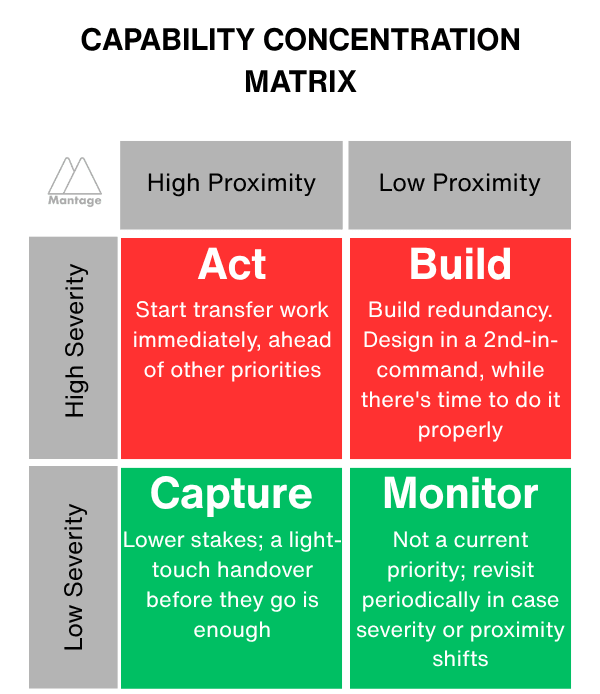
Businesses that try to fix Capability Debt everywhere at once run out of energy and stop. Businesses that address the two or three highest-risk concentration points build momentum, see the value clearly, and continue.
Tool 2: Separate Documentation from Transfer
Documentation – writing down what's known – and transfer – making sure someone else can actually do it – are different problems. Businesses frequently solve the first and assume they've done both.
For each concentration point, decide what is actually needed: a written process, a recorded walkthrough, a shadowing period, a formal handover project. Match the method to how tacit the knowledge is. Highly tacit, relationship-based knowledge requires overlap and shadowing; a wiki page won't cover it.
Build real transfer time into the plan. If someone is leaving in four weeks and the knowledge is deep, four weeks probably isn't enough. Plan earlier, not as an exit event.
Tool 3: Build Capability Development Into the Operating Rhythm
Make "who else could do this" a standing question in resourcing and planning conversations – not a one-off exercise but a recurring one, especially before growth pushes, reorganisations, or key contract endings.
For fractional and contractor engagements specifically, build knowledge transfer into the contract and operating rhythm from day one: regular structured handover sessions, shared documentation as a deliverable, not a courtesy extended at the end of the relationship.
Reward people for building shared capability, not just for being indispensable. If the incentive structure rewards being the only person who knows something, even without saying so directly, don't expect people to document themselves out of value.
Tool 4: Design Roles Around Redundancy, Not Just Efficiency
When designing a role or team structure, ask explicitly where single points of failure are being created – and whether that's an acceptable short-term trade-off or a risk that needs mitigating.
Pair critical knowledge areas with at least partial redundancy: a second person who understands enough to keep things running, even if they are slower or less fluent than the primary owner. This is a leadership and operations design decision, not an HR policy. It belongs in how work gets structured.
Efficiency-only design concentrates capability by default, because it's always faster to let one person own something completely. Redundancy has to be a deliberate choice, because it will never be the path of least resistance.
The mentoring dimension: Much of this requires raising a conversation that leaders often avoid – naming, directly, that the business is dangerously dependent on a specific person. Done well, this conversation is about protecting both the business and that person's own career mobility. Nobody wants to be so essential they can never take leave, get promoted, or move on. Done badly, it lands as leadership planning for their replacement. This is as much a communication and mentoring skill as an operational one.
The Realities of Addressing Capability Debt
Addressing Capability Debt is possible and worthwhile, but it also involves trade-offs.
It costs time now to save time later – and "later" doesn't feel urgent until it is. Every hour spent documenting or cross-training is an hour not spent on delivery. That trade-off is often hard to justify in a busy growing business. The honest answer isn't "make time for everything." It's to prioritise by severity and proximity (Tool 1) and accept that most Capability Debt will remain unaddressed at any given time. The goal is reducing the worst exposure, not eliminating the debt.
Some people resist being documented. People whose value is partly built on being indispensable may resist knowledge transfer – consciously or not. This is a rational response to perceiving that their security depends on being the only person who knows. The reframe is the one in Tool 4: shared capability protects their career options rather than diminishing their value. That conversation requires care to land correctly.
Documentation goes stale. Written processes decay as businesses change. A knowledge base that isn't maintained becomes actively misleading rather than merely incomplete. This is why capability-building needs to be a rhythm embedded in operations (Tool 3), not a one-off sprint. Treat documentation as a living asset with an owner.
Some knowledge can't be fully transferred. Deep client trust, negotiation history, relational nuance – some capability cannot be fully moved to a document or even to a second person. Some risk here is irreducible. The realistic goal is reducing exposure and shortening recovery time, not eliminating the risk entirely.
None of this is a reason not to start. It's a reason to be realistic about scope, sequence the work by risk, and treat capability-building as an ongoing discipline rather than a project with a finish line.
Capability Debt in the Wider Organisation
Capability Debt rarely exists in isolation. It is often the flip side of Operational Debt: undocumented processes are usually also undocumented knowledge, held by whoever built the process. It interacts with Cultural Debt: single points of failure breed resentment among the people covering the gaps, and a culture that doesn't reward shared ownership will keep recreating concentration points. It is the direct concern of fractional and interim talent management: explicitly time-limited engagements mean the knowledge-transfer clock is always running, and the businesses that handle this well build transfer into the relationship from day one.
Mantage's operations review maps where capability is concentrated – not a headcount exercise but a risk exercise, identifying the real exposure before it becomes a crisis. The mentoring practice supports the harder conversations: helping indispensable people let go of single-threaded ownership without feeling diminished, and helping leaders raise the issue without it landing as a threat. And Mantage's strategy delivery work treats capability planning as a built-in element of resourcing any major initiative – asking "who else could do this" before committing to a plan that depends on one person.
The businesses that handle Capability Debt well don't eliminate their dependency on skilled people – they make sure that skill is a structural asset the organisation holds, not a personal one that can disappear with four weeks' notice.
Ady Coles helps organisations reduce operational friction so strategy has a chance to work. He focuses on operational clarity, sensible governance, and the thoughtful use of automation; not optimisation for its own sake, but making work easier, decisions clearer, and scale more sustainable as organisations grow.